

Virtually Fabulous
Here's the reality of knitting design, small business ownership, and AI image generation.

New Shawl Rabbit Hole
I just got done putting together the Lost River Shawl knitting pattern I’m sending to paid subscribers. For anyone else who wants it, it’ll be available on Ravelry and on wooltribe.co.
I had to laugh at the image I chose for the cover. It’s an AI generated model sitting in a rowboat, in the ocean, surrounded by chaos. This whole vibe will be immediately understood by knitters. IYKYK. I used this image once before for social media. Here it is on the cover of the pattern. If you look closely, you’ll notice a typo on this draft that alludes to the possibility that this is a dystopian future setting.
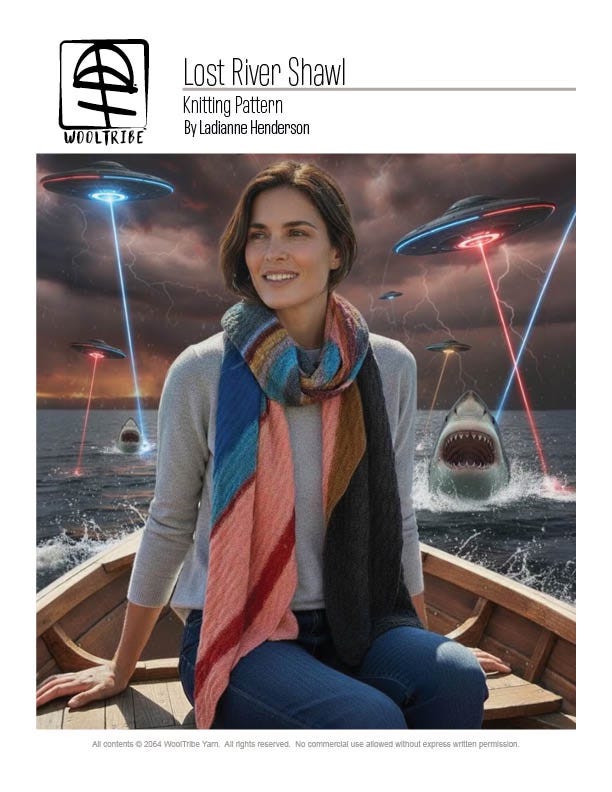
At any rate, there is so much conversation about AI—about image generation and about the resources it uses. We are a very small business, and like many small businesses, we don’t have scads of models and photographers at the ready. Nor do we have coffers in our budget to pay such folks. We’ve done photo shoots in the past, and they are fabulous affairs—full of creative people, and the kind of magic you only get by working with humans. But those events require a pretty hefty budget. Plus, when you need to put a shawl you’ve knit onto someone other than yourself (or your business partner), AI seems like the next logical step. But then there is, again, that question of resources used.
Asking the AI about AI
I turned to the Google and asked it to compare generating a single AI virtual model image to manufacturing one pair of jeans. To be fair, I chose that comparison because I will eternally be shocked that 85% of clothing ends up in landfills, and because it would take one person about 7–10 years to drink the amount of water it takes to make one pair of jeans. True story.
Here’s what Google told me:
Generating a single AI virtual model image consumes significantly fewer physical, natural resources than manufacturing a physical pair of jeans. While AI image generation is energy-intensive, it primarily uses electricity and water for server cooling, whereas a pair of jeans requires immense quantities of water, land, agricultural chemicals, and petroleum-based materials. [[1](https://wiesmade.com/blogs/denim/how-sustainable-denim-is-transforming-the-jeans-industry#:~:text=Sustainable Materials: Organic Cotton and,reduces the overall cotton content.), [2](https://www.facebook.com/groups/1404116417142065/posts/1480205719533134/#:~:text=Other posts,recyclable pile of electronic waste.)]
Key Natural Resource Comparison:
Water Usage: Producing one pair of jeans consumes roughly 1,800 to 2,600 gallons (approx. 7,000–10,000 liters) of water, largely for growing cotton. In contrast, generating a single AI image consumes between 5 to 50 liters (approx. 1.3 to 13 gallons) of water for cooling data centers.
Energy Consumption: A single high-quality AI image (e.g., using GPT-4o) emits approximately 5.6g of CO2e, equivalent to charging a smartphone. The total energy to make one pair of jeans is roughly 33 kg of CO2e, which is thousands of times higher than one AI image.
Physical Raw Materials: Jeans require substantial land for cotton farming, as well as chemical dyes, polyester (petroleum), and metal rivets. AI images require no physical raw materials, although they rely on hardware (GPUs) that creates electronic waste. [1, [2](https://gluecksstern.de/en/blogs/news/jeans-production#:~:text=long transport routes.-,Cotton Cultivation – The High Price of Natural Fibers,term loss of soil fertility.), [3](https://sustainableai.substack.com/p/how-energy-intensive-are-ai-generated#:~:text=TLDR: AI images are energy,up real energy costs%2C fast.), [4](https://modaknits.com/what-are-the-raw-materials-for-jeans-production/#:~:text=Share,materials are becoming more popular.), [5](https://www.facebook.com/groups/1404116417142065/posts/1480205719533134/#:~:text=Other posts,recyclable pile of electronic waste.), [6](https://wiesmade.com/blogs/denim/how-sustainable-denim-is-transforming-the-jeans-industry#:~:text=Sustainable Materials: Organic Cotton and,reduces the overall cotton content.)]
Detailed Resource Breakdown:
Resource [[1](https://www.feathernweave.com.au/blogs/blog/why-denim-production-needs-to-become-more-sustainable#:~:text=1.,to rethink denim production processes.), [2](https://www.facebook.com/groups/1404116417142065/posts/1480205719533134/#:~:text=Other posts,recyclable pile of electronic waste.), 3, [4](https://gluecksstern.de/en/blogs/news/jeans-production#:~:text=long transport routes.-,Cotton Cultivation – The High Price of Natural Fibers,term loss of soil fertility.), [5](https://wiesmade.com/blogs/denim/how-sustainable-denim-is-transforming-the-jeans-industry#:~:text=Sustainable Materials: Organic Cotton and,reduces the overall cotton content.), [6](https://modaknits.com/what-are-the-raw-materials-for-jeans-production/#:~:text=Share,materials are becoming more popular.)]AI Virtual Image (Single)Pair of Jeans (Single)Water$\approx$5–50 liters (for cooling)$\approx$2,000–10,000+ liters (farming/dyeing)LandNegligibleLarge amount for cotton farmingEnergyMedium (Electricity for GPU)High (Spinning, weaving, washing, transport)MaterialsNone (Digital)Cotton, polyester, metals, dyeWastePotential E-wasteTextile waste, Chemical water pollution
Contextual Impact:
While individual AI images are “lightweight,” the cumulative impact of millions of queries is rising. However, AI in the fashion industry is used to replace physical samples, potentially saving thousands of liters of water and eliminating the waste associated with producing, shipping, and disposing of a physical garment. [[1](https://www.adobe.com/products/substance3d/magazine/3d-denim-is-the-most-ethical-sustainable-denim-in-the-world.html#:~:text=First%2C as mentioned%2C the digitization,costing and overall lead time.), [2](https://www.linkedin.com/posts/sharon-lombardo-3b382a6_artificial-intelligence-is-often-criticized-activity-7423797302898733056-yq44#:~:text=Artificial intelligence is often criticized,and discarding a physical one.), [3](https://vigneshwaranmm.medium.com/carbon-emissions-of-generative-ai-queries-vs-web-browsing-06db8166c5a9#:~:text=With millions of queries processed daily%2C the,the Earth multiple times in a year.), [4](https://techxplore.com/news/2025-04-lightweight-ai-high-quality-image.html#:~:text=A new ultra-lightweight artificial intelligence (AI) model,without directly sending sensitive data to servers.), [5](https://www.greenredeem.co.uk/are-you-inadvertently-increasing-your-carbon-footprint-with-ai/#:~:text=AI image generation?,where the servers are operating.)]
A Verdict… and the Question That Led to It
Interesting, to be sure. Now, one more question for “The Googs.” So, for companies like ours—whose owners aren’t model/photog types (although we have been known to attempt such feats)—what’s the verdict? Is it better for us to aim for live folks for a shoot? Or is it better, environmentally speaking, to generate an AI model wearing our design? Here’s what we found:
Replacing a physical photo shoot with an AI-generated image drastically reduces resource consumption. While the AI process is purely digital, a live shoot involves significant transportation emissions and on-site energy use.
Resource Comparison: AI Image vs. Live Location Shoot
This table compares generating one AI image to a professional shoot in Charlotte, NC, involving five people(Model, Photographer, Assistant, and two WoolTribe owners) driving 30 minutes each in separate vehicles.
ResourceOne AI-Generated ImageLive Professional Photo ShootWater~0.00026 to 0.5 Liters**~50 - 150+ Liters** (Travel & On-site)Carbon (CO₂e)~0.1 to 2 Grams**~36,000 - 45,000+ Grams** (36-45 kg)Energy~0.012 to 0.02 kWh**~15 - 25+ kWh** (Transport & Gear)
Impact Breakdown
Transportation (The Heavy Hitter): The largest impact comes from five separate 30-minute drives (approximately 15–20 miles each).
An average 2026 passenger vehicle emits roughly 400 grams of CO₂ per mile.
With five cars driving a round trip, the total travel alone produces roughly 35–40 kg of CO₂e, which is nearly equivalent to the carbon footprint of making another whole pair of jeans.
On-Site Energy: Professional photography gear, including high-output LED or strobe lighting, cameras, and laptops for tethering, consumes significant electricity. A 200W light used for a few hours, plus the energy to upload and process high-res RAW files, uses far more power than the milliseconds of compute time required for an AI model.
Water Usage: The “hidden” water cost of the live shoot includes the water used in the power generation for the shoot’s electricity and the fuel for the five cars. In contrast, AI water usage is restricted to data center cooling.
Human Element: While AI is “greener,” industry experts note that it “deletes the need” for fashion’s creative middle class, such as local photographers and assistants in cities like Charlotte.
Back to… Reality?
I had to do it. I went back to AI and put a heavy dose of reality into the mix. Make her over 55. Menopausal. Make her hair gray. No—grayer. Make her hair wiry on top, untamable by even the best hairspray. Give her a stain on the knee of her jeans. Put her cell phone on the bench, alongside a plastic cup someone left behind and the photo/model team forgot to take out of the frame. Put some hair across her face because the breeze kicked up at just the wrong moment. Then add a dog getting ready to do its business just as the photo is taken. Oh, and make sure to leave a bit of the photographer’s finger in the frame. Reality? In our world… probably, yes. All of that. Oddly, adding all of that made the Lost River Shawl itself look far less… real.
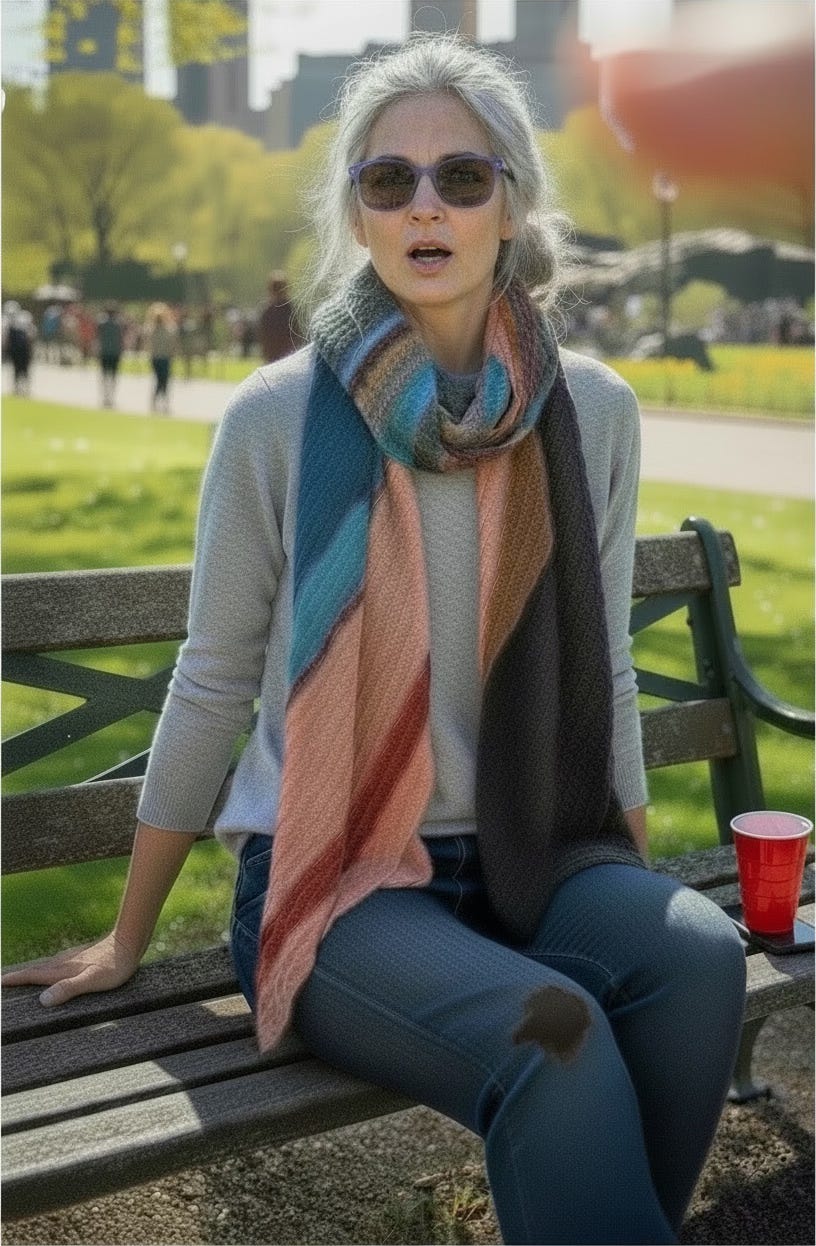
Virtual Valerie gets to experience some very real factors. Spills, untimely breezes, unruly gray hair, and an errant photog finger are all part of our life from time to time.
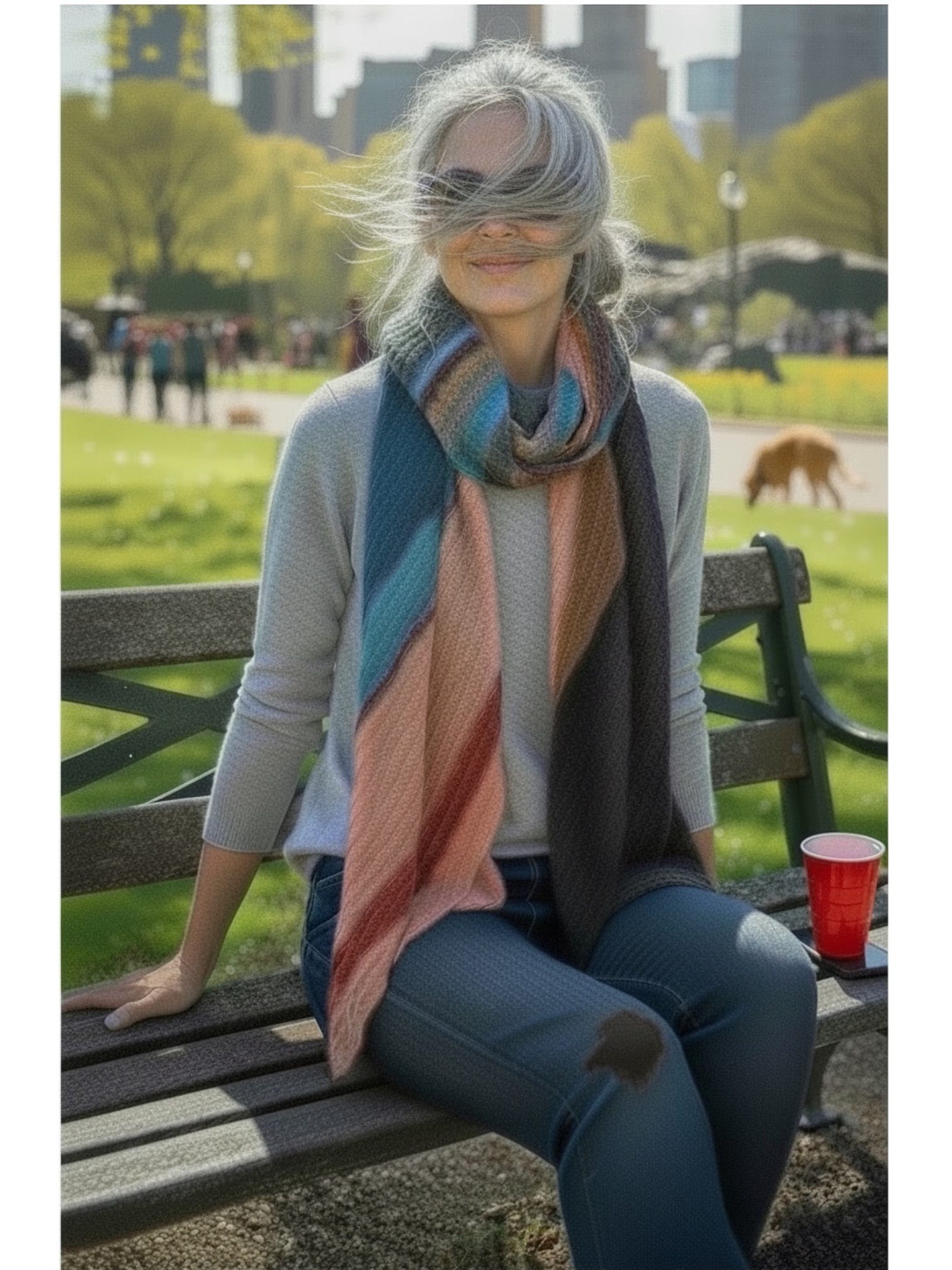
The upshot of all of this? Given the opportunity, I’ll take real humans any day over AI-generated models. But given the opportunity, I’ll also use AI to help manage our budget so our small business can keep chugging along until we’re able to call up our photog faves, grab a group of models, and do another in-the-flesh photo shoot. But since THAT will cost us, and the planet, a bunch more, we’ll save that party for a very special occasion.
Cheers!